If you are renting an apartment or a house, your home is your safe haven. But what happens if a sudden disaster—like a massive kitchen fire, a burst winter pipe, or severe storm damage—makes your apartment completely uninhabitable? You are forced to pack whatever you can salvage and find a place to sleep. Suddenly, you are staring down the barrel of expensive nightly hotel bills, eating out for every meal, and paying for extra commute costs.
At this terrifying moment, one critical question crosses every renter’s mind: Does renters insurance cover hotel stays?
The short answer is Yes. Most standard renters insurance policies will cover your hotel stays and other related costs if a covered disaster forces you out of your rented home.
However, dealing with insurance is rarely as simple as a basic “yes.” There are specific rules, limits, and conditions you must meet. In this comprehensive guide, we will break down exactly how this coverage works, when your insurance company will pay, when they will absolutely deny your claim, and how you can ensure you get every penny you deserve.
By the end of this article, you will be an expert on how to protect your finances when the unexpected happens.
1. The Magic Words: “Loss of Use” Coverage
To understand how your renters insurance pays for your hotel, you need to understand three important words in the insurance world: Loss of Use.
Also known as Additional Living Expenses (ALE), this is a standard section built into almost every traditional renters insurance policy (often labeled as Coverage D on your policy declaration page).
What Exactly is Loss of Use (ALE)?
”Loss of Use” coverage kicks in when your rented home becomes temporarily unlivable due to a peril (a disaster or event) that is explicitly covered by your insurance policy.
The core philosophy of ALE is simple: Your insurance company wants to help you maintain your normal standard of living while your home is being repaired.
If you normally pay $1,500 a month in rent, but now you have to pay $3,000 a month to live in a hotel, ALE is designed to step in and cover that extra $1,500 difference. It bridges the financial gap between your normal life and your temporary, disaster-disrupted life.
2. When DOES Renters Insurance Pay for Your Hotel? (Covered Perils)
Your renters insurance will not pay for a hotel just because your air conditioning broke for a day or because you had a fight with your roommate. The event that forces you out of your home must be a “Covered Peril.”
Here is a detailed breakdown of the common disasters that will trigger your “Loss of Use” coverage and get your hotel bill paid:
🔥 Fire and Smoke Damage
This is the most common reason renters use their ALE coverage. If a fire starts in your kitchen, or if an electrical fire breaks out in the walls, the resulting fire, smoke, and soot damage will almost certainly make the apartment unsafe to live in. Even if the fire was in a neighboring apartment but the smoke heavily damaged your unit, your hotel stay is covered.
💧 Sudden and Accidental Water Damage
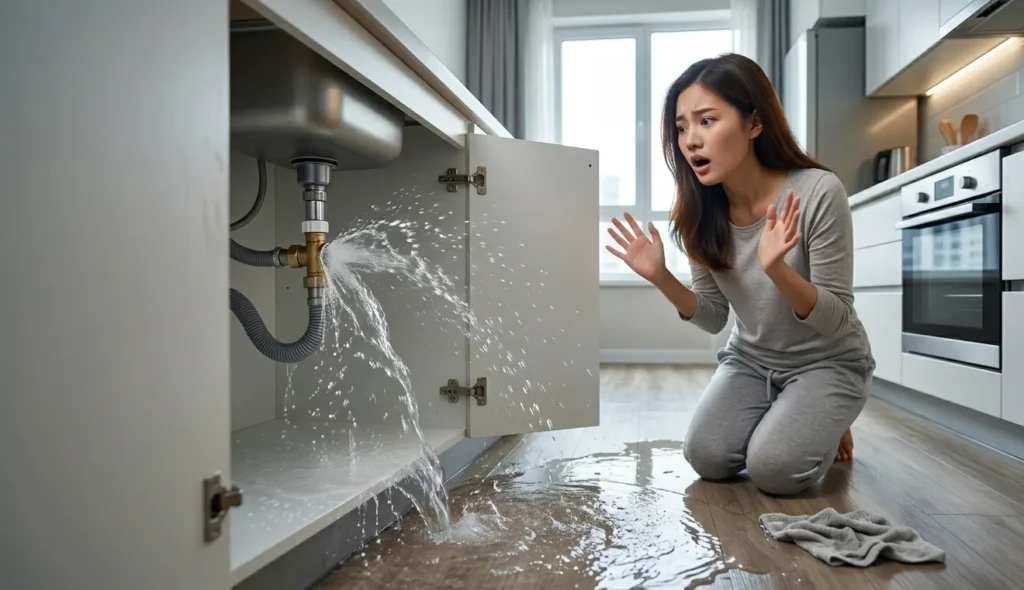
Notice the words “sudden” and “accidental.” If a pipe bursts in the middle of winter, or if your upstairs neighbor’s bathtub overflows and the ceiling collapses into your living room, you are covered. The water damage makes the home uninhabitable, and your insurance will pay for your temporary lodging.
🌪️ Windstorms and Hail
If a severe storm, tornado, or hurricane blows the roof off your apartment building or smashes your windows, exposing your home to the elements, this is a covered peril. Your insurance will safely house you in a hotel while the landlord repairs the structural damage.
💥 Explosions
Whether it is a gas leak explosion in your building or a nearby industrial accident that damages your rental unit, explosions are standard covered perils.
🧊 Weight of Ice, Snow, or Sleet
In colder climates, heavy snowfall can cause roofs to cave in. If the structural integrity of your rental is compromised by winter weather, making it dangerous to stay, your hotel bills will be covered.
🚗 Vehicle or Aircraft Impact
It sounds like an action movie, but cars do crash into apartment buildings. If a vehicle plows into your ground-floor apartment and destroys your living room, your insurance will cover your hotel stay while the wall is rebuilt.
🛑 Mandatory Evacuations (Civil Authority)
If a massive wildfire is approaching your neighborhood, or a chemical spill happens down the street, local law enforcement (civil authorities) may issue a mandatory evacuation order. Even if your apartment hasn’t caught fire yet, most renters insurance policies will cover your hotel stay for a limited time (usually up to two weeks) because a civil authority forced you out due to a covered peril in the immediate vicinity.
3. When WILL NOT Renters Insurance Pay? (The Exclusions)
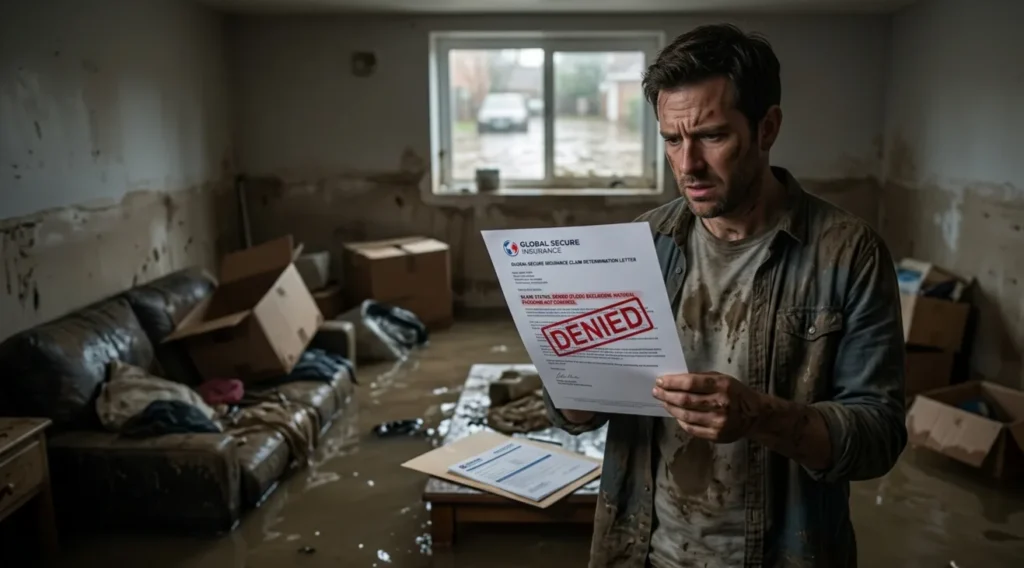
Understanding what is not covered is just as important as knowing what is. If you leave your apartment for any of the following reasons, your renters insurance will deny your hotel claim:
🌊 Natural Flooding
Standard renters insurance never covers natural flooding. If heavy rain causes a nearby river to overflow, or a storm surge brings ocean water into your home, your policy will not cover the damage to your stuff, nor will it pay for your hotel. You would need a separate, specific Flood Insurance policy for this.
🌍 Earthquakes
Just like floods, earthquakes and sinkholes (earth movements) are generally excluded from standard policies. If an earthquake damages your building, you are on your own for the hotel bill unless you purchased a specific earthquake endorsement.
🪳 Pest Infestations (Bedbugs, Roaches, Rats)
If your apartment becomes overrun with bedbugs, cockroaches, or rodents, it might feel uninhabitable to you. However, insurance companies consider pest control to be a maintenance issue. They will not cover your hotel stay while the exterminator works.
🔧 Routine Maintenance and Wear & Tear
If your landlord needs you to vacate the apartment for three days to install new flooring, paint the walls, or fix a slow, long-term plumbing leak, your renters insurance will not pay for a hotel. Maintenance is not a “sudden and accidental disaster.”
🦠 Mold (Usually)
Mold is a tricky subject. If mold grows over a long period because of high humidity or a slow, hidden pipe leak you ignored, it is considered a maintenance failure and is not covered. However, if a pipe suddenly bursts, the water is cleaned up, but mold still develops rapidly as a direct result of that specific burst pipe, you might have limited coverage depending on your specific policy.
😡 Roommate Disputes or Evictions
If you break up with your partner, have a massive fight with your roommate, or get an eviction notice from your landlord, your renters insurance will not rescue you. Insurance only covers physical disasters to the property, not personal or legal issues.
4. Beyond the Hotel: What Else Does “Loss of Use” Cover?

One of the biggest secrets in the insurance world is that “Loss of Use” (ALE) covers much more than just your hotel room. Remember the golden rule: It covers the difference between your normal living expenses and your disaster living expenses.
Here is a comprehensive list of what you can claim under ALE:
- Restaurant Meals and Groceries: If your hotel room doesn’t have a kitchen, you are forced to eat at restaurants. If you normally spend $100 a week on groceries, but now spend $300 a week eating out, the insurance company will reimburse you for the $200 difference.
- Pet Boarding: If the hotel does not allow dogs or cats, your insurance will pay the daily fees to keep your pets safe in a boarding kennel.
- Extra Commuting Costs: If your hotel is 20 miles further away from your workplace than your apartment was, the insurance company will cover the extra gas money or additional public transit fares you have to pay.
- Laundry and Dry Cleaning: If your apartment had a washing machine, but your hotel charges expensive dry-cleaning fees, ALE covers the extra cost of keeping your clothes clean.
- Storage Units: If you had to hurriedly move your surviving furniture out of the damaged apartment so contractors could work, ALE will pay for the temporary storage unit rental.
- Moving Costs: The cost of hiring movers to transport your salvaged belongings from the damaged apartment to the storage unit or your temporary hotel.
⚠️ The “Normal Expenses” Catch
It is crucial to understand that insurance only pays the excess amount. They will calculate what your normal life costs, and subtract that from your current expenses.
Example: You normally pay $1,500/month in rent. You are displaced for a full month. Your hotel costs $3,000 for the month. Since you are not paying your landlord the $1,500 rent that month (because the apartment is uninhabitable), the insurance company will only pay the remaining $1,500 for the hotel. You still have to contribute your normal housing budget.
5. The Limits of Coverage: How Long Can You Stay?
Renters insurance is not an unlimited blank check. There are strict caps on how much the insurance company will pay, and how long they will pay it. You need to check your specific policy for two types of limits:
Financial Limits (The Cap)
Most commonly, your “Loss of Use” coverage is calculated as a percentage of your total Personal Property coverage limit.
- Scenario: Let’s say you have $30,000 in personal property coverage to protect your furniture and electronics.
- The Limit: Many policies set ALE at 20% to 30% of your personal property limit.
- The Result: In this scenario, 20% of $30,000 is $6,000. That means $6,000 is the absolute maximum amount the insurance company will pay for your hotel, extra food, and travel combined. Once you hit $6,000, you are entirely on your own.
Time Limits (The Clock)
Even if you haven’t reached your financial cap, most policies have a strict time limit. Standard policies will generally cover your living expenses for the “shortest time required to repair or replace the damage,” or until you permanently relocate elsewhere.
Usually, there is a hard cap of 12 months (or sometimes 24 months). If it takes the landlord 14 months to rebuild a fire-destroyed building, your hotel coverage will abruptly end at the 12-month mark.
6. Step-by-Step Guide: How to File a Hotel Claim
When disaster strikes, panic is natural. But taking the right steps immediately can mean the difference between a fully paid hotel stay and a denied claim. Follow this step-by-step blueprint:
Step 1: Ensure Your Safety First
Do not worry about receipts or insurance while the building is burning. Call 911, evacuate immediately, and make sure your family and pets are safe.
Step 2: Contact Your Landlord
Once you are safe, notify your landlord or property management company immediately. They need to secure the property, shut off water or gas mains, and start their own insurance claims for the building’s structure.
Step 3: Call Your Renters Insurance Company ASAP
Do not book a $500-a-night luxury suite before speaking to your insurance agent. Call your insurer’s 24/7 claims hotline immediately.
- Tell them your home is uninhabitable.
- Ask for an immediate advance. Many insurers will wire you funds or cut a check within 24 hours so you can pay for the first few nights at a hotel and buy emergency clothes or toiletries.
- Ask them about your specific ALE limits.
- Ask if they have partner hotels. Some insurance companies can directly book and pay for a hotel for you, meaning you don’t have to pay out-of-pocket and wait for reimbursement.
Step 4: Document Everything (The Proof)
Before leaving the damaged apartment (if it is safe to enter), take dozens of photos and videos of the damage. You need undeniable proof that the home is unlivable to justify your hotel stay to the insurance adjuster.
Step 5: Save Every Single Receipt
This is the most critical step. The insurance company will require proof of every extra dime you spend. Keep a dedicated folder or an envelope for:
- Hotel invoices
- Restaurant bills (itemized, not just the credit card summary)
- Gas station receipts (if your commute is longer)
- Laundromat receipts
- Pet boarding invoices
Step 6: Maintain a “Disaster Diary”
Create a simple spreadsheet or use a notebook to log your daily expenses. Write down what you bought, why you needed it, and the cost. This makes submitting your claim at the end of the month incredibly smooth and prevents the insurance company from finding reasons to deny specific expenses.
7. Real-Life Scenarios: How it Actually Plays Out
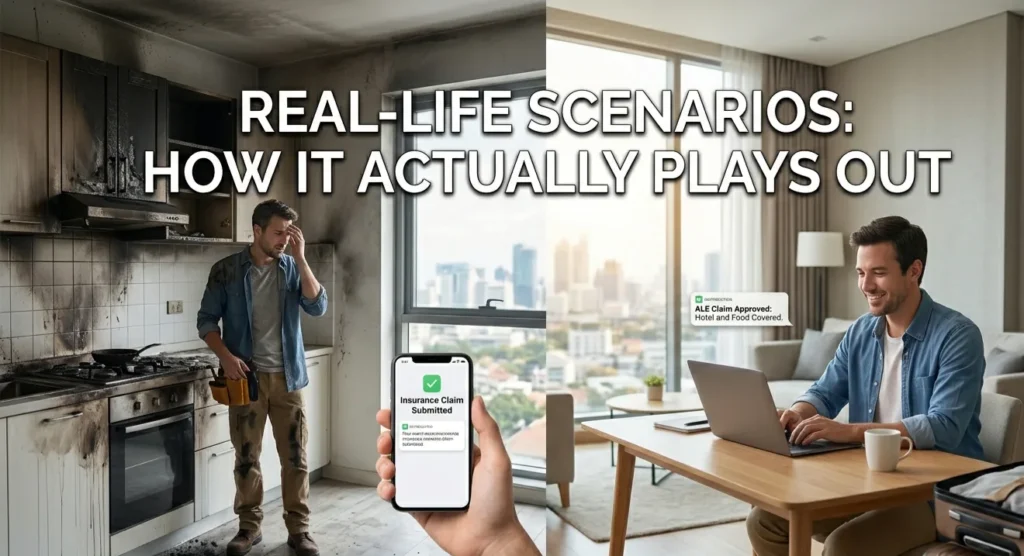
To make all this insurance jargon easy to understand, let’s look at three real-world examples of how renters insurance handles hotel stays.
Scenario A: The Kitchen Fire
The Event: Mark accidentally leaves a pan of oil on the stove. It catches fire, destroying the kitchen and filling the apartment with toxic smoke.
The Verdict: COVERED. Fire and smoke are covered perils. Mark’s renters insurance will pay for a hotel while the landlord spends three weeks gutting and replacing the kitchen. They will also pay for Mark’s restaurant meals, since he can no longer cook at home.
Scenario B: The Flash Flood
The Event: A massive summer storm causes a nearby creek to overflow. Two feet of muddy water rushes into Sarah’s basement apartment, ruining everything and making it unsafe due to bacteria.
The Verdict: NOT COVERED. Natural flooding is explicitly excluded from standard renters insurance. Sarah will have to pay for her own hotel stay unless she specifically purchased a separate flood insurance policy beforehand.
Scenario C: The Neighborhood Gas Leak
The Event: A construction crew down the street accidentally ruptures a massive natural gas main. The fire department forces everyone in a 5-block radius to evacuate for three days while they secure the leak. David’s apartment is perfectly fine, but he isn’t allowed to go home.
The Verdict: COVERED. Because a “Civil Authority” (the fire department) ordered a mandatory evacuation due to a covered peril (risk of explosion) nearby, David’s insurance will cover his 3-day hotel stay.
8. Pro Tips to Maximize Your Claim
Insurance companies are businesses, and their goal is to minimize payouts. To ensure you get the maximum benefit from your policy without headaches, keep these pro tips in mind:
- Don’t Upgrade Your Lifestyle: Insurance pays to maintain your current standard of living, not improve it. If you rent a modest $1,000/month studio apartment, the insurance company will not pay for a 5-star luxury hotel penthouse. They will cover a standard room at a Holiday Inn or Marriott. If you book the penthouse, you will pay the difference out of pocket.
- Use Credit Cards for Tracking: Pay for all your temporary living expenses with a single credit card. This creates a clear, undeniable digital paper trail of your spending, making it much easier to reconcile with the insurance adjuster later.
- Negotiate Long-Term Stays: If your apartment will take three months to fix, staying in a hotel gets exhausting and expensive (eating through your policy limit quickly). Work with your adjuster to rent a short-term, fully furnished corporate apartment instead. It is usually cheaper than a hotel and gives you a kitchen, saving the insurance company money on your food bills and giving you a more comfortable life.
- Communicate in Writing: Whenever you speak to your insurance adjuster, follow up with an email summarizing what was said. (“As we discussed on the phone today, you approved my stay at the Courtyard Marriott for the next 14 days.”) This prevents “misunderstandings” later when it’s time to cut the check.
Conclusion: Peace of Mind in a Crisis
Dealing with a disaster that forces you out of your home is one of the most stressful experiences a renter can face. The sheer cost of finding a safe place to sleep can bankrupt a family in a matter of weeks.
This is why understanding your renters insurance is so vital. Yes, renters insurance absolutely covers hotel stays, but it relies entirely on your “Loss of Use” coverage, the nature of the disaster, and your diligence in keeping receipts.
Take 15 minutes today to pull out your renters insurance policy. Check your “Coverage D” or “Loss of Use” limits. Make sure you have enough coverage to sustain you for a few months in a worst-case scenario. For a few extra dollars a month in premiums, you can ensure that if the worst ever happens, your only worry will be keeping your family safe—not how you are going to pay the hotel bill.